the 2025 annual report
In 2025, the National Endowment for Democracy stood with courageous partners navigating a world marked by both democratic openings and intensifying authoritarian repression. Across regions, citizens pressed for greater voice, dignity, and accountability. NED supported these locally led efforts to defend fundamental freedoms, including speech, religious belief, association, and thought, by backing citizen-led movements, protecting independent media, strengthening electoral integrity, and reinforcing accountable, rules-based governance where it mattered most.
The 2025 Annual Report highlights how NED’s flexible, partner-driven model enables democratic actors to seize moments of opportunity, endure periods of crackdown, and sustain long-term movements for change. From countering censorship and transnational repression to supporting civic innovation, religious freedom, and democratic resilience, the report underscores a core truth: lasting democratic progress is driven by empowered citizens. As the United States approaches its 250th anniversary, NED’s work reflects a distinctly American tradition—standing with people around the world as they pursue their own freedom.
download 2025 annual report
Introduction: Standing with Those Who Choose Freedom
By NED President and CEO Damon Wilson and NED Board Chairman Peter Roskam.
Two hundred and fifty years ago, the United States embarked on an audacious experiment. Our Founders, invoking the self-evident right of citizens to think, speak, worship, and govern themselves freely, launched a revolution that reshaped the modern world. Yet America’s struggle for independence was never ours alone. It succeeded because friends of freedom abroad stood with our struggle.
The Marquis de Lafayette, Baron Friedrich Wilhelm von Steuben, Tadeusz Kościuszko, Casimir Pulaski, and Bernardo de Gálvez stood with the American cause—some crossing the Atlantic to serve alongside George Washington, others fighting on distant fronts that proved decisive to independence. This support manifested not only on battlefields, but through ideas, solidarity, and civic courage. Dutch financiers took great risks to support the fledgling Continental Congress. European newspapers and public thinkers amplified the ideals of liberty and self-government. Reformers and republicans across France, the Netherlands, and Poland saw in America’s revolution a shared aspiration. Citizens across Europe and throughout the Western Hemisphere watched, debated, and stood with a bold, untested republic as it staked its claim to freedom. From the beginning, America’s story has been intertwined with the struggles of people far beyond our borders. John Adams’ reminder that “liberty once lost is lost forever” resonated with movements for independence worldwide. As the United States grew, so did our tradition of standing with those pursuing the same dream.
That tradition only deepened over the next two centuries. Americans rallied free nations in World War II, helped rebuild Japan and Europe, supported democratic movements across the Eastern bloc, and stood with dissidents whose courage helped bring down the Berlin Wall.
At every moment of democratic peril, Americans recognized a simple truth: when we help others secure their freedom, we strengthen our own. As our nation celebrates its 250th anniversary in 2026, NED’s work honors this distinctly American conviction.
Dramatic political developments created both new opportunities and new urgency for democratic action in 2025. Around the world, moments of political opening emerged alongside intensifying repression, testing whether democratic gains could take hold.
In several countries, long-closed systems cracked open. In Bangladesh, the eighth-most populous country in the world, we witnessed authoritarian collapse and an unexpected opening for civic space, youth engagement, and competitive politics. Because Congress entrusted NED with flexible contingency funding, we were well positioned to surge resources quickly and help local actors seize the moment, strengthening early efforts to rebuild civic norms and ensure democratic participation. In Syria, the collapse of the Assad regime in late 2024 ended five decades of atrocities and repression, opening space for civic actors long forced underground to push for peace, security, and the establishment of core democratic norms and procedures.
In Bolivia, elections ushered in democratic renewal, ending one-party dominance. In Moldova, voters rejected Russian interference and backed reform and European integration. In Benin, citizens successfully fended off an attempted military coup.
At the same time, authoritarian backlash exacted a heavy toll. In Venezuela, the regime sought to cling to power despite overwhelming evidence of the opposition’s electoral victory, responding with harsh repression that left civic and political life under assault. Yet even amid this crisis, NED partners safeguarded independent information, protected at-risk activists, and sustained the peaceful movement for democratic transition. In Burma, citizens weathered airstrikes and resisted sham elections aimed at legitimizing the junta. In Sudan, mass atrocities accompanied the Rapid Support Forces’ capture of El Fasher. In Iran, the energy of the Woman, Life, Freedom movement continued to drive civic resistance despite intensifying repression and mass executions, and NED partners ensured that evidence of abuses reached the world. In Tanzania and Cameroon, protesters faced attacks as they challenged fraudulent elections. And in Serbia and Georgia, courageous youth, independent media, and determined civic watchdogs continued to defend democratic processes even as backsliding deepened.
Repressive regimes, fearful of their own people, imprisoned some of the most prominent advocates for democracy, illustrated by such cases as Tundu Lissu in Tanzania, Mzia Amaglobeli along with most of the leaders of the opposition in Georgia, Ekrem Imamoğlu in Turkey, Pastor Ezra Jin in China, Narges Mohammadi in Iran, and Moussa Mara of Mali. While Jimmy Lai faced sentencing in Hong Kong, the releases of José Daniel Ferrer of Cuba and Ales Bialiatski and Maryia Kalesnikava in Belarus offered rare moments of relief amid sustained repression.
Across Africa, Latin America, and Asia, citizens continued to press forward despite the risks.Youth-led mobilization surged from Peru, where Gen Z-driven protests challenged political exclusion, to Nepal, Madagascar, Morocco, and Kenya, where young people asserted their voice in public life and demanded more responsive, democratic governance. These movements are not just about who governs, but how societies organize, how information flows, and how a digital-native generation expects meaningful agency in its future.
These next-generation democratic activists are embracing new tools to reclaim civic space and overcome repression. They are using artificial intelligence to even the odds. From open-source verification to encrypted communications, civic technologists are gaining access to the same tools autocrats have long exploited. Digital resilience and tech-enabled openness are increasingly central to 21st-century democracy support.
The strength of these civic movements is their deep connections to the populations they seek to represent, but they do not operate on a level playing field. As authoritarian regimes, which depend heavily on the support of other authoritarian states, adapt, using surveillance, censorship, and coercion to raise the cost of participation, democracy assistance becomes even more critical to help civic and political actors innovate, strategize, and mobilize to build broad coalitions to advance the cause of freedom.
In 2025, NED expanded support where authoritarian pressure continues to harden. We increased support for networks focused on China, Russia, and Iran to counter digital censorship, economic coercion, targeting of religious communities, and transnational repression. We protected high-risk partners in Cuba, ensuring independent journalists, labor organizers, faith leaders, and human rights defenders can continue operating in one of the world’s most tightly controlled environments. And we increased investment in digital resilience, helping civic actors circumvent surveillance, preserve open information channels, and sustain accurate, fact-based reporting. Through rapid-response mechanisms, NED moved quickly to address the immediate needs of partners as the military junta intensified its violent repression in Burma.
All of this unfolded against the backdrop of continuing and serious threats to democratic governance posed by China and Russia. Both regimes are refining a model of authoritarianism that blends digital surveillance, cross-border repression, and strategic coercion. China’s economic authoritarianism, driven by forced labor, state-directed capital, and the weaponization of supply chains, poses a direct challenge to U.S. prosperity and to the rules-based system that underpins global stability.
Meanwhile, Russia continues its war of aggression in Ukraine with systematic attacks on civilians and critical infrastructure, while also exporting state-sponsored deception and political interference to destabilize democracies in Europe and beyond. These threats reinforce why strengthening democratic resilience is essential to America’s own security.
Across these diverse contexts, one truth stands out: when autocrats attempt to deprive citizens of their fundamental freedoms, many look to NED because we stand with them as partners in their own struggle, supporting their right to shape their future and drive change from within.
That is why NED’s mission remains so vital. We carry forward a distinctly American tradition: supporting people in their peaceful struggle for their own freedom. Our comparative advantage lies in the depth and durability of our engagement. It lies in the relationships of trust we maintain with those behind the frontlines of freedom.
For decades, we have supported independent voices in some of the world’s most restricted environments, often long before the international community recognizes the scale of repression. Our flexible, direct model allows us to back courageous leaders, sustain long-term movements, and strengthen civic ecosystems in ways few institutions can. We support the ground game without which there is no democratic renewal. NED is America’s foundation for freedom, rooted in the belief that the single most effective and durable engine for democratic change is empowered citizens dedicated to advancing their own freedom.
As we mark America’s 250th anniversary,we see real opportunities for progress. We are focused on what this moment requires and are working alongside partners whose courage drives democratic change around the world.
Over the past year, we undertook a significant transformation to sharpen NED’s approach, strengthen our tools, and maximize our agility. We made difficult decisions in the face of challenge and uncertainty, including reducing our workforce so that more of our resources could flow directly to the brave individuals and organizations advancing freedom on the frontlines.
We also invested in strategic capabilities that reflect America’s longstanding commitment to innovation in service of liberty. Our “venture capital for freedom” approach identifies high-potential civic leaders early and backs visionary democratic entrepreneurs working in some of the world’s most challenging environments. By supporting courageous individuals long before their names reach the global stage, NED has partnered with civic and political leaders who have gone on to receive 17 Nobel Peace Prizes.
We have embraced a leaner, tech-enabled operating model that can move resources faster and more securely. We’ve streamlined internal processes, embedded agility into every layer of our work, and strengthened our ability to respond when openings appear or crises erupt. New tools, from AI-enabled efficiencies to secure, scalable digital payment systems, position us to deliver support even in hard-to-reach environments, from conflict zones to dictatorships.
We also launched the Impact Lab, a center that uses evidence, applied research, and learning to strengthen how NED invests in democracy. The Lab helps us measure what works, identify trends, and ensure lessons from the field shape future strategy, making NED smarter, more effective, and more adaptive.
As part of this renewal, we are reshaping the Reagan–Fascell Democracy Fellows Program into NED’s democracy accelerator. This next chapter builds on a two-decade legacy by bringing together a focused group of civic leaders, technologists, and scholars to refine transformative ideas, collaborate across the NED family, and address the transnational challenges facing democracy. The accelerator will serve as a hub for democratic experimentation and applied learning, generating solutions with impact far beyond the fellowship year.
Looking to 2026 and beyond, we will continue to invest most heavily in Asia, even as our most significant growth in grantmaking occurs in Latin America and the Caribbean. China-related programs—spanning the Mainland, Tibet, East Turkestan, Hong Kong, and China’s global influence— will remain our single largest area of investment.
In the coming year, we will commit increased resources to Cuba, sustain long-term commitments in Ukraine and Burma, and maintain recent growth in Venezuela and Iran. We will also support opportunities for democratic advancement in the Philippines, Armenia, Nigeria, and Colombia. Across our portfolio, we are prioritizing support for elections, revenue-generating investments, media experimentation, religious freedom, and the use of AI to advance freedom.
Several strategic countries will require especially focused attention in the year ahead. In Thailand, Venezuela, Syria, Bangladesh, and Nepal, we see developments that could become geopolitically consequential. In Thailand, with elections likely in 2026, the trajectory of democratic reform will matter deeply for Southeast Asia. In Venezuela, the democracy movement’s clear electoral mandate and the regime’s ensuing crackdown have created a volatile moment, where any democratic opening will require sustained support for citizens working to rebuild civic life and institutions after years of authoritarian erosion. In Syria, new partners working to ensure a historic opportunity leads to a more participatory, open, and free country will require increased engagement and backing.
We will double down in 2026—investing, helping succeed, and surging where openings appear— because the stakes are high. Our support for scalable civic innovation in Bangladesh demonstrates what is possible when agility meets opportunity. At the same time, our work in countries facing sharp crackdowns, such as Tanzania and Nicaragua, will remain vital as authoritarian consolidation deepens and civic actors search for pathways to defend their rights.
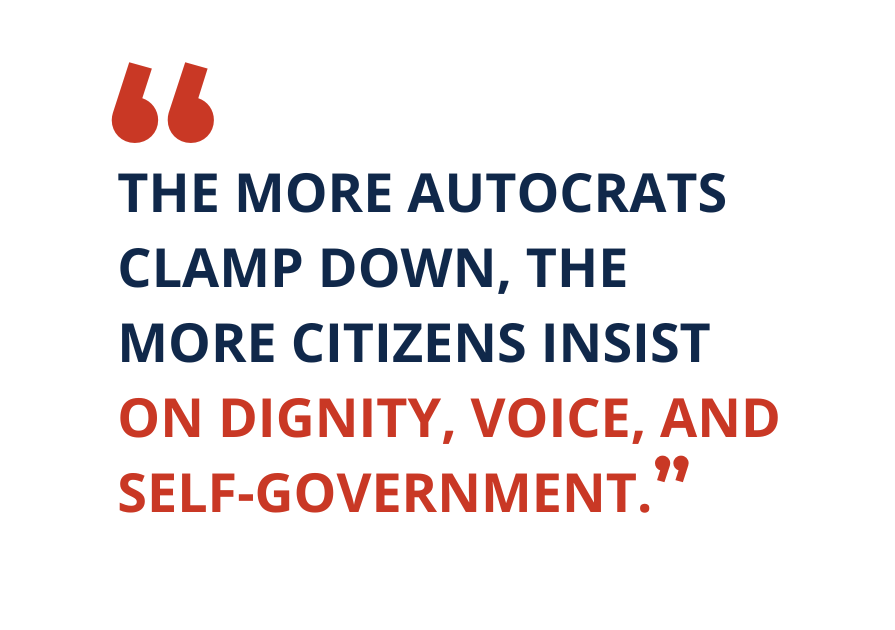
We recognize that we are operating in a world where the brakes on freedom have been hit hard: surveillance, censorship, data capture, and shrinking civic space are now defining features of the global landscape. Yet these tactics are themselves evidence of demand. The more autocrats clamp down, the more citizens insist on dignity, voice, and self-government—whether through civic action, independent journalism, or the simple assertion of conscience and religious belief beyond the reach of the state.
As we commemorate America’s 250th year, the Endowment’s role within this larger story is clear. We honor our own founding not with celebration alone, but with service. We stand with people around the world who, like America’s patriots in 1776, confront oppression with courage, creativity, and imagination.
Our founding faith in democracy endures. Our partners’ courage inspires us. And our mission—to ensure people everywhere can determine their own future with dignity and freedom—remains urgent, essential, and profoundly American.
The world is watching to see whether freedom-loving people have the resolve to defend liberty when it matters most. At NED, that resolve is unwavering.
2025 Year in Review

NED-Approved grantmaking for FY2025 to direct partners and the Core Institutes for country-and regional-based programming.