
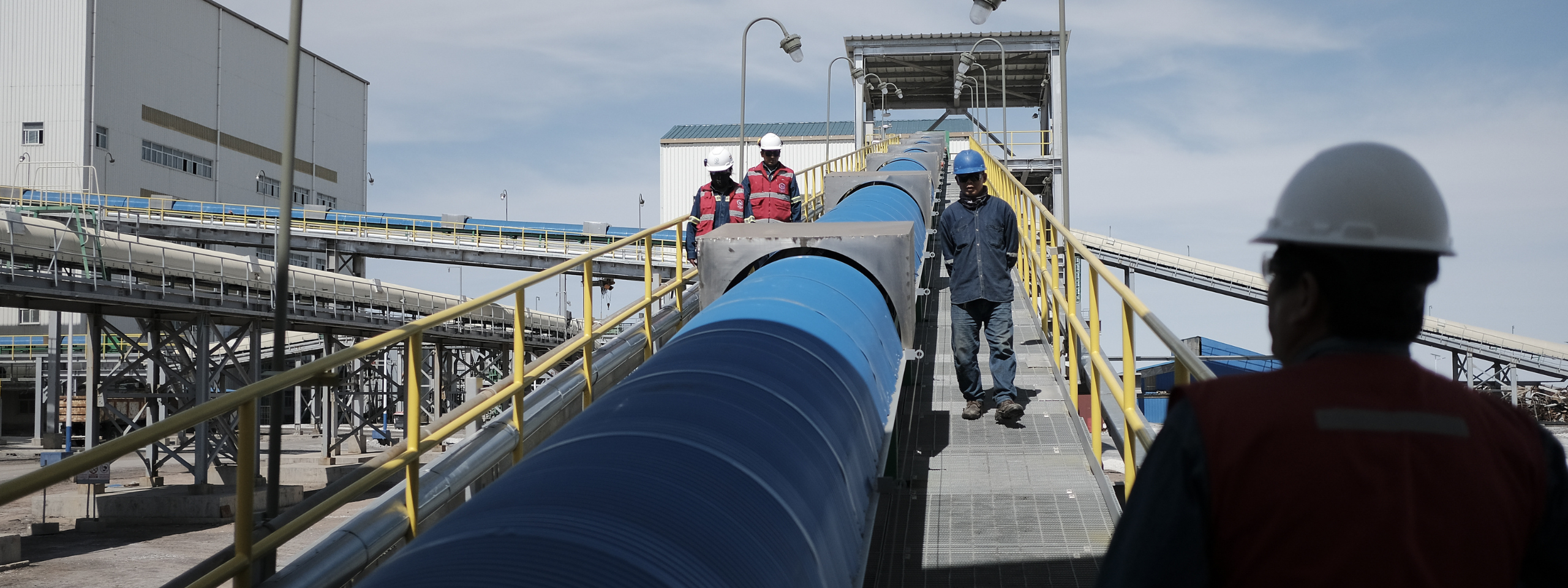
In The National Interest, Damon Wilson, President and CEO of the National Endowment for Democracy, explains how NED partners help create conditions for resilient supply chains that strengthen the U.S. economy. Read the op-ed below (originally published on February 4, 2026):
Supporting freedom around the world is a key advantage to American firms and a challenge for Russia and China.
This week, Secretary of State Marco Rubio is convening an inaugural ministerial in Washington focused on the critical mineral supply chains that underpin America’s economy, military, and technological edge. As policymakers focus on production targets and processing capacity, they should keep the fundamental strategic reality in mind: a supply chain agreement is only as strong as the institutions and people responsible for enforcing it.
State-to-state agreements matter. Strategic partnerships matter. And the administration’s focus on strengthening supply chains with trusted partners is essential. Those efforts are most effective, however, when enforcement does not rest solely at the top. Economic partnerships last when transparent governance ensures a level playing field for U.S. companies and limits opportunities for authoritarian coercion over time.
That challenge is especially acute because many of the minerals essential to America’s energy systems, defense industries, and advanced technologies are mined and processed in countries where governance is weak, and market oversight is limited. In those environments, even well-structured agreements can expose US companies to financial and operational risks if local enforcement fails.
Weak governance also locks U.S. companies out of critical markets while creating openings for authoritarian governments, state-linked firms, and corrupt domestic elites. In corrupt systems, licenses and mineral contracts are often predetermined for insiders. Even when American firms offer better technology and more local jobs, they lose out to bribery-based competition that distorts markets and costs the United States access to strategic resources.
China’s dominance across key stages of critical mineral processing underscores the stakes. America’s reliance on imported lithium, cobalt, graphite, and rare earth elements creates vulnerabilities that can be exploited by the Chinese Communist Party and other adversaries. Addressing those vulnerabilities requires attention not only to where minerals come from, but to whether decisions on the ground are governed by transparent rules and credible enforcement, rather than debt leverage or opaque financing.
That concern has been echoed at the highest levels of U.S. policy. The recent Donald Trump administration policy has emphasized diversifying supply chains, reducing reliance on adversarial nations, and strengthening reliable sources for the United States. Doing so requires more than high-level agreements. It depends on whether countries have the capacity to enforce contracts, protect investment, and keep strategic resources from slipping into authoritarian hands.
This is where governance and economic freedom determine whether US investments are protected or exposed.
Transparent rules and accountable institutions help create environments where fair competition can take root, and U.S. companies can invest with greater confidence. Countries with these foundations are better positioned to manage strategic resources responsibly, attract reliable investment, and resist coercion by authoritarian powers that thrive in the absence of oversight.
This is also where the National Endowment for Democracy plays a distinct, complementary role. NED does not negotiate contracts or manage mines. Instead, NED and its core institute, the Center for International Private Enterprise, support local civic leaders who strengthen the enforcement capacity that makes agreements work in practice. Those partners work with government officials, civic groups, journalists, economists, think tanks, and community leaders to monitor contracts, expose corruption, and improve transparency in critical mineral sectors. By embedding oversight locally, these efforts reduce risk for U.S. companies and reduce the need for the United States to police outcomes from afar.
In Bolivia, civic groups exposed nearly $2 billion in opaque contracts that would have handed control of the country’s lithium reserves to Russia- and China-linked firms. By equipping local experts with credible analysis and public platforms, these efforts helped stop deals that lacked transparency and democratic oversight. Bolivians asserted control over their resources, protected national sovereignty, and safeguarded a key link in the global lithium supply chain.
The Democratic Republic of the Congo offers a similar lesson. Home to some of the world’s most important reserves of cobalt and other critical minerals, the DRC’s extractive sector has long been vulnerable to opaque deals and foreign influence, including from CCP-backed enterprises. NED-supported partners are helping local communities expose corruption and monitor high-stakes mining agreements. This strengthens on-the-ground enforcement and reduces the risk that weak governance undermines US investment and supply-chain security.
Across Africa and Latin America, civic leaders supported by NED have pushed for greater oversight in strategic sectors such as infrastructure and mining, strengthening accountability and limiting elite capture.
For the United States, supporting democracy and self-governance abroad is a practical, low-cost way to reinforce its supply chain strategy and reduce risk. It lowers the chances that American companies and workers face unfair competition, that agreements unravel under external authoritarian influence, and that US taxpayers are left absorbing the costs when opaque deals fail.
Ministerials and high-level agreements are essential, but they work best when partners enforce their own laws and uphold their commitments, not when the United States is left guaranteeing the consequences of governance failures elsewhere.
This article originally appeared in The National Interest, on February 4, 2026, and is available here.