
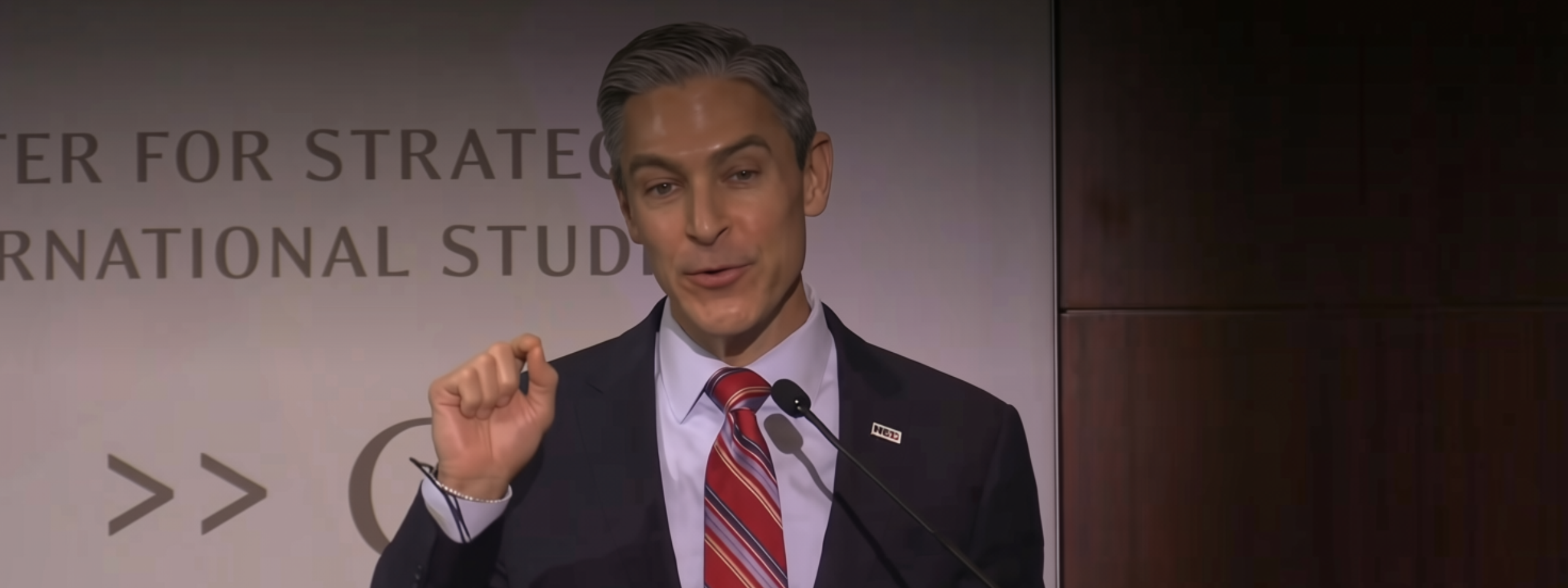
On October 14, NED President and CEO Damon Wilson delivered remarks at “Without Parallel: North Korean Human Rights and the Russia Axis,” co-hosted by the Center for Strategic and International Studies (CSIS) and the George W. Bush Institute in Washington, D.C. The event marked the launch of a new report examining how North Korea’s state-sponsored trafficking of workers to Russian drone factories supporting Russia’s unprovoked war against Ukraine. Wilson presented closing remarks on the importance of supporting a free North Korea. Learn more about the event here.
*****
From Repression to Aggression—and a Different Future for North Korea
Thank you, Victor. And thank you for your service on the NED Board.
My thanks to CSIS and the George W. Bush Institute for bringing us together, and especially to Victor Cha and Joseph Kim for this important report. Thanks also to David Kramer, Representative Young Kim, Olivia Enos, and our panelists, Thae Yong-ho and Sokeel Park, for helping illuminate what is at stake.
I want to close by asking us to consider three lives described by the patterns documented in this report. A young woman from Africa. A North Korean worker. And a Ukrainian teenager.
Imagine a young African woman who sees an advertisement offering a job in Russia. Good wages. New opportunities. Perhaps the chance to help her family. She accepts. Instead, she finds herself assembling drones. Her passport is confiscated. Her movements are restricted.
Consider a North Korean worker who has even less choice. Sent abroad by a regime that controls his life, he helps produce weapons while Pyongyang confiscates most of his wages.
And hundreds of miles away, imagine a Ukrainian teenager hearing the terrifying buzz of an approaching Shahed drone, running for shelter.
These three people may never meet. But their lives are connected by an extraordinary and deeply disturbing system. Human beings are being exploited to build weapons that kill other human beings. And the proceeds help sustain the regimes responsible.
That is the story of Yelabuga. And that is why this report matters.
Repression at home. Aggression abroad.
We often discuss human rights and national security as if they were competing priorities. We are told that human rights are important, of course—but when it comes to the hard business of geopolitics, we must be realistic. Well, this report shows us what realism actually requires.
Iran provides the drone technology. China supplies critical components and facilitates supply chains. Russia manufactures and deploys the weapons. North Korea supplies laborers whose freedom and wages are effectively confiscated by their own government.
These regimes are not identical. They do not share every interest. They are not a formal alliance. But they have learned to cooperate in ways that make each more dangerous.
What begins as repression at home becomes aggression abroad. The same system that denies North Koreans their freedom helps produce weapons that terrorize Ukrainian civilians. The same system that confiscates workers’ wages generates resources for a regime developing nuclear weapons and ballistic missiles. And the technical expertise North Koreans acquire in Russia may eventually strengthen Pyongyang’s military capabilities, threatening South Korea, Japan, and American forces.
This is not a distant human rights problem. It is a threat to our security. We should stop treating the defense of human dignity as something separate from the defense of our interests.
I recently returned from South Korea, where I was struck by the extraordinary courage, imagination, and determination of the young North Koreans I met. What stayed with me most was not the cruelty of the regime, but the extraordinary potential of the people it seeks to control.
Artists. Entrepreneurs. Scholars. Technologists. Advocates. They are not simply survivors of repression. They are emerging leaders already helping imagine and build a different North Korea.
Their existence reveals something important about the regime itself. Kim Jong Un is building nuclear weapons and sending troops and workers to support Russia’s war. Yet he is also terrified of a teenager watching a South Korean drama.
Think about that.
His regime has adopted sweeping laws criminalizing foreign media, South Korean expressions, and the cultural influences that young people encounter. Young North Koreans have faced years of hard labor for watching videos or listening to music that millions of South Koreans enjoy without a second thought.
Why would a nuclear-armed dictator fear a song? Because a song can open a window. A drama can invite comparison. An uncensored conversation can raise questions that propaganda cannot answer.
Kim Jong Un fears ideas because ideas help people discover their own agency. But information alone is not enough. Information must lead to understanding. Understanding to independent judgment. Independent judgment to agency. And agency to leadership.
That is the long-term investment that can help change North Korea.
So what should we do with what we have learned today?
First, expose and disrupt the machinery of repression. Identify the recruiters, intermediaries, and front companies trafficking people into Russia’s war industry. Sanction those responsible. Shut down deceptive recruitment operations. Document abuses, protect victims, and pursue accountability. Make the exploitation of human beings more difficult, more costly, and less profitable.
Second, match authoritarian cooperation with democratic cooperation. The CRINK regimes are learning from one another, trading with one another, and helping one another evade accountability. Those defending freedom must become equally effective at working together.
At NED, we’re already seeing this cooperation in action. Our partners at the Citizens’ Alliance for North Korean Human Rights in Seoul, working with Russian investigators, exposed more than 70 Russian companies and institutions linked to North Korean forced labor—revealing how exploitation and sanctions evasion help finance Pyongyang’s weapons programs.
This is precisely the kind of cross-border collaboration we need to scale. Authoritarian networks turn repression into power. Democratic networks must turn solidarity into action.
And third—and perhaps most important—invest in the people who can build a different future.
In July 2024, a remarkable group of young North Korean escapees gathered in Washington, including here at CSIS. Artists. Entrepreneurs. Scholars. Emerging civic leaders. Together, they drafted the “Washington Declaration for the Dignity, Hope, and Freedom of North Koreans.”
Consider the contrast. Kim Jong Un’s regime produced laws designed to isolate young people, punish curiosity, and suppress independent thought. These young North Koreans produced a declaration founded on dignity, hope, freedom, and action.
They committed themselves to empowering North Koreans, developing new leaders, and using their professions to help shape their country’s future. They expressed the hope that their small ripples would become a tidal wave of change.
I believe they can. But hope is not a strategy unless we invest in it.
That means sustaining independent information, strengthening North Korean-led organizations, and investing in emerging leaders—not only human rights advocates, but entrepreneurs, artists, journalists, technologists, and those who will someday help build the institutions of a freer North Korea.
And we don’t have to look far for evidence of what that investment can mean. Joseph Kim is here with us today.
As a boy in North Korea, Joseph lost his father to starvation. He survived hunger and life on the streets before escaping the country and eventually finding refuge in the United States. He arrived with little reason to believe that he would someday help shape international policy.
Yet here he is. A scholar and advocate. A leader at the George W. Bush Institute. And now co-author of a report exposing how the very regime that denied him freedom is exploiting other North Koreans to help Russia wage war.
Think about that extraordinary journey. A boy who once struggled simply to survive under this regime is now helping hold that regime accountable before the world.
Joseph’s story is remarkable. But it should not remain exceptional. There are other young North Koreans with the courage, talent, and determination to become leaders, if we help create the opportunities for them to do so.
In 1982, President Ronald Reagan stood before the British Parliament at Westminster and called for fostering the “infrastructure of democracy.” He understood that freedom cannot simply be imposed from outside. It requires people and institutions capable of holding power accountable and shaping their own futures.
That conviction helped inspire the National Endowment for Democracy. And it remains central to our mission.
We cannot predict when change will come to North Korea. But we can help ensure that North Koreans have the information, skills, relationships, institutions, and confidence to seize opportunities when they arise. And we can help expand their agency today, even in the absence of a political opening.
Let me return to those three lives. The young woman deceived into working in a Russian drone factory. The North Korean laborer whose government treats him as a resource to be exploited. The Ukrainian teenager running for shelter.
Their stories remind us what happens when governments treat people as instruments of the state rather than human beings with rights and dignity.
But Joseph’s story—and the young North Koreans I met in Seoul—remind us of something else. People are not simply the victims of history. They can be its authors.
Our task is to confront the machinery that turns repression into aggression—and invest in the people capable of building something better.
So let us leave today determined to do both. Expose the networks. Disrupt the exploitation. Hold the perpetrators accountable. And invest in the rising generation of North Koreans who can help write a different future.
That is how we defend human rights. That is how we advance our security. And that is how we help freedom prevail.
Thank you.
****