
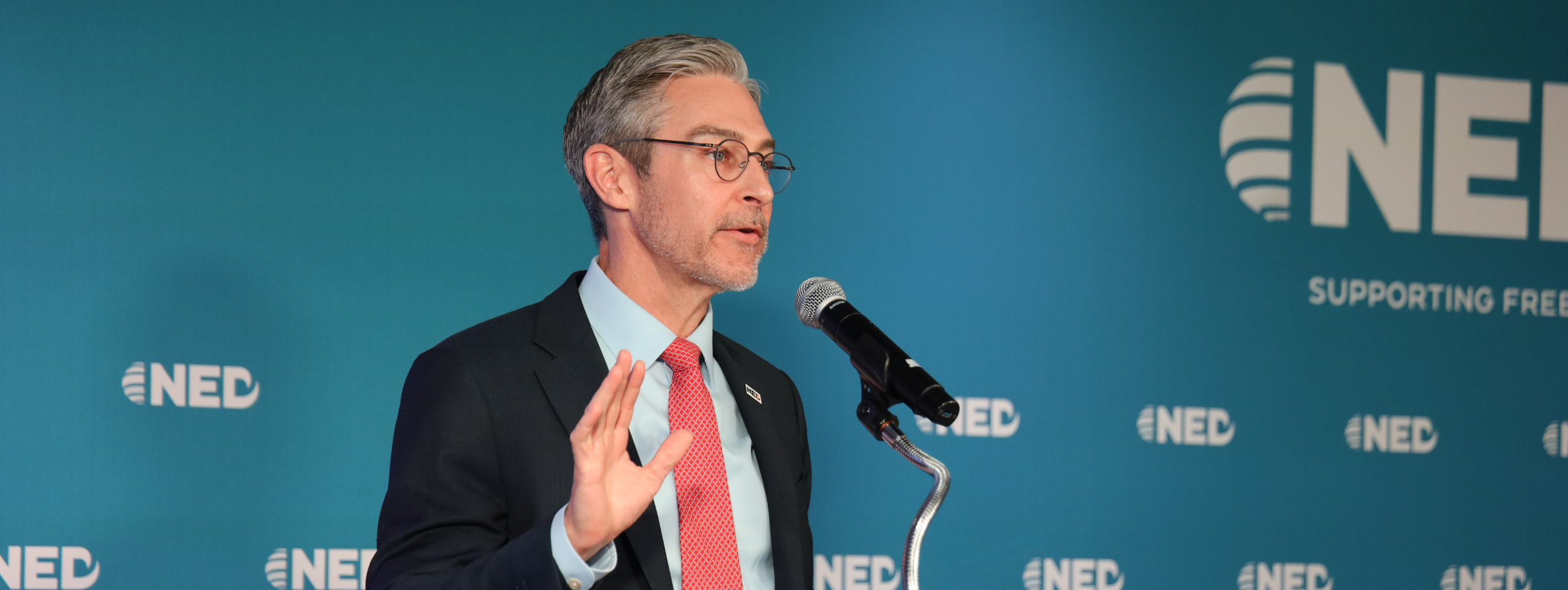
On August 25, 2026, NED President and CEO Damon Wilson delivered remarks at the Endowment’s “Beyond the Taliban: Five Years of Afghan Resilience and Resistance” event, highlighting the courage and determination of Afghanistan’s pro-democracy movement to shape a freer future for their country five years after the Taliban’s return to power.
****
Good morning, everyone, and welcome to the National Endowment for Democracy.
Thank you for joining us for Beyond the Taliban: Five Years of Afghan Resilience and Resistance.
And let me especially welcome the remarkable group of Afghans, diplomats, journalists, advocates, and longtime friends of Afghanistan who are with us today. We are honored to have former U.S. Ambassadors Ryan Crocker, Ronald Neumann, and John Bass; former Afghan Ambassador Adela Raz; former Under Secretary Uzra Zeya; Ambassador Melanne Verveer; Fawzia Koofi; Nick Schifrin; Annie Pforzheimer; and, most importantly, so many Afghan civic leaders and partners whose work is the reason we are here.
Five years after the Taliban returned to power, much of the world’s conversation about Afghanistan is still about the Taliban—their repression, their policies, and their efforts to consolidate authoritarian rule. Those realities matter. But if our understanding of Afghanistan begins and ends with the Taliban, we are missing much of the story.
Because the Taliban are not Afghanistan. There is another story unfolding—one of Afghans continuing to report, teach, organize, advocate, research, and defend fundamental freedoms; of women refusing to disappear from their country’s public life; of independent journalists getting credible information to people inside the country; and of civic and political leaders working across communities and borders to preserve the possibility of a different future.
I saw a powerful reminder of that just on Sunday when I visited the studios of Amu TV. I watched Jan-e Gap—“Heartbeat of Afghanistan”—a live call-in program. In the span of that program, nearly 3,000 Afghans from across the country called in—simply for the opportunity to participate, to ask questions, exchange ideas, and have their voices heard.
It was an extraordinary reminder. The Taliban may control the state. But they do not control what Afghans think, what they aspire to, or the future they imagine for their country.
NED has had the privilege of standing with Afghans seeking a freer future since 1984—more than forty years. So we have endured through dark times, giving oxygen to the light.
Over that time, through NED’s direct grants and the work of our four Core Institutes, we have invested approximately $82 million through nearly 600 projects supporting more than 100 Afghan organizations. Those investments helped Afghans build a broad democratic ecosystem—independent media and civil society, policy research and education, women and youth leaders, and civic networks across the country.
The collapse of the Republic in 2021 dismantled much of the institutional and political environment in which these people worked. But it did not erase the people. It did not erase their experience, their relationships, their knowledge, or the networks they had built.
And so our work changed.
Since 2021, NED’s focus has shifted from helping expand democratic space to helping preserve democratic actors, networks, and independent voices; support their efforts to contest the consolidation of authoritarian rule; and advance the prospects for a future democratic Afghanistan.
Today, NED is investing approximately $2.5 million through 24 active grants supporting this work. Those investments center on three mutually reinforcing priorities: ensuring Afghans have access to independent media and credible information; defending human rights, particularly the rights of women and marginalized communities; and strengthening coordination and leadership among Afghan democratic actors.
That last piece is especially important. Afghanistan’s democratic and political forces will be strongest when they can overcome old divisions and build a credible, inclusive alternative around a shared national vision—a vision in which Afghans of different backgrounds can see themselves and their future.
None of us should pretend this is easy. Afghanistan today represents the world’s most severe crisis for the rights of women and girls. International attention has diminished. And after the experience of the past two decades, Americans should approach questions about Afghanistan’s political future with humility.
But humility cannot become indifference.
There is a fundamental difference between outsiders trying to determine Afghanistan’s future and standing with Afghans determined to shape their own.
NED remains committed because Afghanistan’s democratic story did not end in August 2021. The next chapter will ultimately be written by Afghans themselves.
Our responsibility is to help ensure that the people, knowledge, networks, independent voices, and democratic ideas developed over decades are not lost—and that when opportunities for democratic change emerge, Afghans have the strength and capacity to seize them.
That is why we are here today. Not simply to mark five years since the Taliban takeover, or to litigate the past, but to look beyond the Taliban—to the Afghans resisting repression, preserving pluralism, sustaining independent voices, and keeping alive the possibility of a freer, democratic future for their country. And to ask what we can do to ensure they do not stand alone.
It is now my privilege to introduce two people whose service has intersected with my own at very different moments—and whose commitment to Afghanistan and its people I have had the privilege to witness firsthand.
First is Ambassador Ryan Crocker, who has served our country in some of its most consequential and difficult diplomatic assignments, including as Ambassador to Afghanistan, Iraq, Pakistan, Syria, Kuwait, and Lebanon.
I had the privilege of watching Amb Crocker in action in Baghdad when I served at the U.S. Embassy in Iraq. I saw firsthand the extraordinary combination of judgment, courage, persistence, and respect for the people of the region that has defined his service.
Ryan understands perhaps better than most that America’s engagement in places like Afghanistan is ultimately about people—about relationships and trust built over years, and about the consequences when those relationships are tested.
In addition to serving six times as a U.S. ambassador, today he serves on the bipartisan Afghanistan War Commission, chairs the Middle East Broadcasting Networks, and remains one of America’s most respected diplomatic voices on Afghanistan and the region.
Please join me in welcoming Ambassador Crocker.
Our second kickoff speaker is Uzra Zeya, President and CEO of Human Rights First. Uzra assumed this role following a distinguished career in American diplomacy, most recently as Under Secretary of State for Civilian Security, Democracy, and Human Rights.
But I also know Uzra from one of the most difficult moments in NED’s history. As Kabul fell in August 2021 and our Afghan partners faced immediate danger, NED made the decision to mobilize our entire institution to help them reach safety.
Uzra was our key interlocutor at the State Department—and helped secure the authorization that allowed NED to use our own funds to finance that evacuation effort.
That decision mattered enormously. It helped us move quickly when hours mattered, and ultimately contributed to our ability to help more than a thousand Afghan partners and their family members reach safety.
So for me, welcoming Amb Crocker and now Uzra today is personal. Both understand the weight of America’s relationships with Afghans. Both have made consequential decisions in moments when those relationships mattered. And both bring to today’s conversation the experience, principle, and humility this subject demands.
Please join me in welcoming Uzra Zeya.
****