
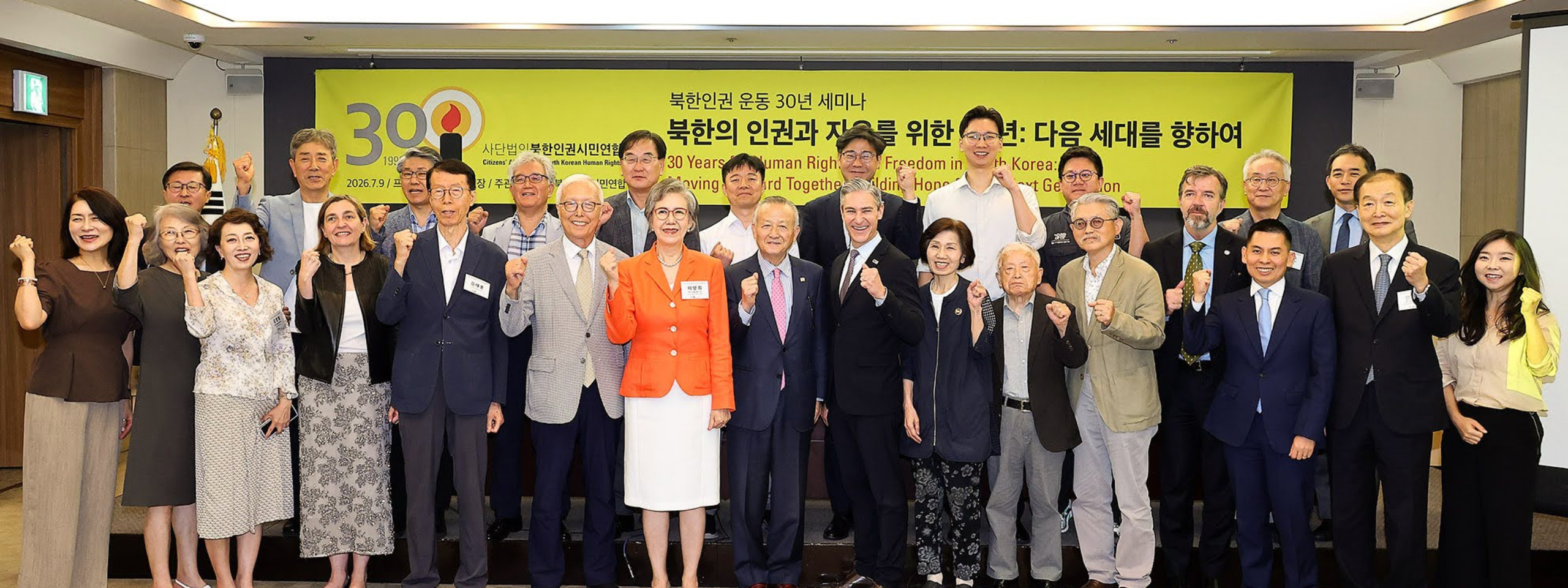
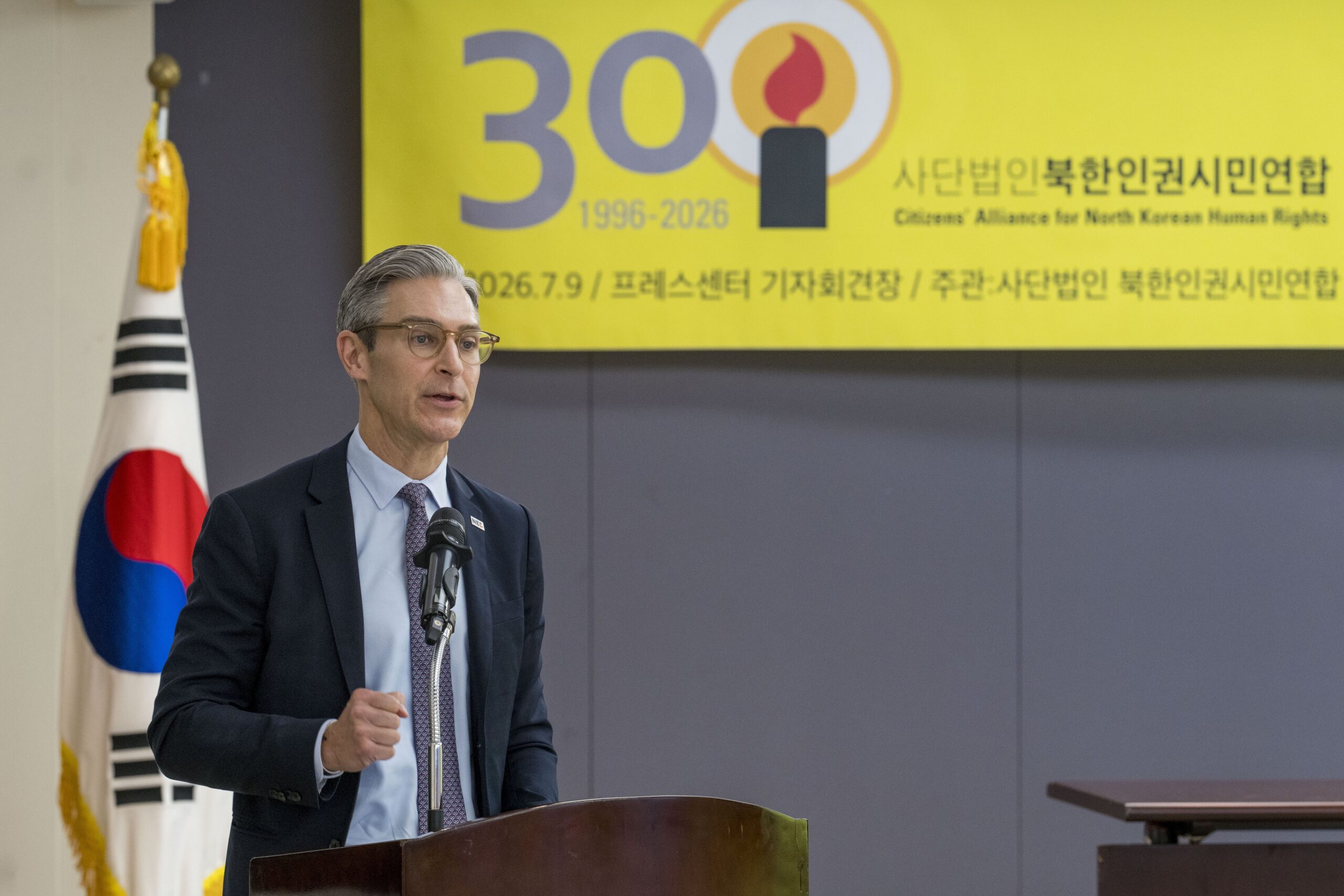
NED President and CEO Damon Wilson delivered congratulatory remarks at the Citizens’ Alliance for North Korean Human Rights’ 30th Anniversary Conference, “From One Spark to a New Generation,” on July 9, 2026, at the Korea Press Center in Jung-gu, Seoul.
****
It is a privilege to join you as we celebrate the 30th anniversary of the Citizens’ Alliance for North Korean Human Rights—NED’s first and longest-standing partner in advancing the human rights and dignity of the North Korean people. On behalf of the National Endowment for Democracy, congratulations on this remarkable milestone.
For three decades, Citizens’ Alliance has been one of the world’s leading voices for the North Korean people. Your work has transformed not only how the international community understands North Korea, but how it responds.
Too often, discussions about North Korea begin and end with missiles, nuclear weapons, and security concerns. Those issues matter. But they should never eclipse the lives, dignity, and fundamental rights of the nearly twenty-six million people who continue to live under one of the world’s most repressive regimes.
When Citizens’ Alliance was founded in Seoul in 1996, few organizations were willing to place the human rights of North Koreans at the center of the international agenda. At a time when geopolitical concerns dominated the conversation, you became the first organization dedicated exclusively to advancing the rights and freedoms of the North Korean people.
Around the same time, as news spread of the horrific man-made famine in North Korea, two members of NED’s Board urged us to begin supporting North Korean human rights. We wanted to help, but as a grant-making institution we faced one challenge: there were simply no established organizations working on the issue that we could support. Then, one day in 1996, a publication titled Life and Human Rights in North Korea arrived at our office. It came from an organization we had never heard of before: the Citizens’ Alliance for North Korean Human Rights.
Looking back, it is remarkable how often history begins with something small—a publication arriving in the mail, a conversation, a shared conviction that something must be done. Before long, Carl Gershman, Louisa Greve, and the NED staff were working with the late Reverend Benjamin Yoon, Youngja Kim, Joanna Hosaniak, and their small team to support Citizens’ Alliance’s first international conference on North Korean human rights.
That partnership, begun nearly thirty years ago, continues today. Like our predecessors, I along with NED Board member Victor Cha as well as staff members Lynn Lee and Jeeyoon Kim, who are with me today, now have the privilege of standing alongside this remarkable organization. It is an honor to continue that tradition.
Reverend Yoon understood something that remains just as true today: peace and human dignity are never competing ideals. There can be no just or enduring peace on the Korean Peninsula while millions of North Koreans continue to live under one of the world’s most repressive and violent regimes. Peace must ultimately be measured not only by reduced military tensions, but by whether all Koreans can live with dignity, freedom, and hope.
Over these three decades, your achievements have been extraordinary. You helped elevate North Korea’s human rights crisis onto the international agenda, contributed to the establishment of the UN Special Rapporteur, and helped lay the groundwork for the landmark UN Commission of Inquiry, whose findings confirmed what courageous North Koreans had long testified: that the Kim regime is responsible for crimes against humanity on a systematic scale.
The continued existence of a regime that systematically imprisons, starves, terrorizes, and denies the basic humanity of its own people should remain a scourge on the conscience of the international community.
Nor has the challenge remained confined to the Korean Peninsula. Your recent work documenting North Korean forced labor supporting Russia’s war against Ukraine reminds us that human rights and international security are inseparable. North Korean workers are exploited abroad to sustain the regime. North Korean soldiers are being sent to fight and die in an unjust war of aggression. A regime that brutalizes its own people now exports that brutality beyond its borders. As authoritarian regimes become more coordinated in undermining freedom, those of us who stand for freedom must become more united in defending it.
At the National Endowment for Democracy, we are proud to have stood alongside Citizens’ Alliance for more than a quarter century. Together, we have documented abuses, preserved the testimony of survivors, expanded North Koreans’ access to independent information, strengthened defector leadership, and elevated North Korean human rights on the global agenda.
But today’s celebration is about more than one organization. It is about a community that has been built over thirty years—researchers, advocates, defectors, donors, scholars, journalists, faith leaders, and friends from around the world. Above all, it is about courageous North Koreans whose voices have transformed this movement.
The progress we have made was never inevitable. It was built patiently through your perseverance and through the courage of countless North Koreans who risked everything to tell the truth. Today, that work remains as urgent as ever. The international environment has changed. Attention shifts. Resources fluctuate. New crises emerge. But the North Korean people’s desire for freedom, dignity, and a better future has not changed.
Nor has the importance of South Korea’s example. South Korea’s democratic journey is one of the great democratic stories of our time. This nation knows from lived experience that democracy is neither inevitable nor irreversible. It was earned through the courage of students, workers, journalists, religious leaders, lawyers, and ordinary citizens who believed their country could be freer, more just, and more democratic. That journey has not ended. Like every democracy, Korea continues to face moments that test the strength of its constitutional institutions and the resolve of its citizens. Time and again, the Korean people have demonstrated that democracy is not merely inherited—it is renewed.
That experience gives South Korea extraordinary credibility. Around the world, people confronting authoritarianism, corruption, propaganda, and democratic backsliding increasingly look to Korea—not only for its remarkable story, but for its ideas, its partnerships, and its example. I am especially encouraged that, across Korea, thoughtful voices are asking how this country’s extraordinary democratic experience can contribute even more to strengthening freedom, good governance, and civic resilience beyond its shores. That is a conversation worthy of Korea’s history, its growing global leadership, and its democratic legacy. South Korea’s greatest contribution to democracy is not simply the story of its own success. It is the confidence it gives others that free citizens can shape their own future.
Perhaps that is why the work of Citizens’ Alliance has always resonated so deeply. You understood from the very beginning that the struggle for North Korean human rights is not simply about documenting repression or exposing atrocities. It is about affirming the humanity of the North Korean people and keeping alive the possibility that one day they, too, will determine their own future.
That conviction has produced real progress. North Korea remains one of the most closed societies on earth. Yet more information gets in. More testimony gets out. More survivors speak. More governments pay attention. More young Koreans are choosing to carry this movement forward. History does not always move quickly. But it does move. And those are genuine reasons for hope.
As we celebrate thirty years of advocacy, we should also ask what the next thirty years require of us. How do we sustain this movement? How do we adapt to new challenges?And how do we prepare a new generation to carry this work forward?
Two summers ago in Washington, we had the privilege of hosting a remarkable group of young North Korean defectors. Among them were a rapper, a cartoonist, an entrepreneur, and other young leaders who had escaped North Korea as teenagers or young adults. Over two days, they shared deeply personal stories. One young woman read a letter to her grandparents—a letter she knew they would almost certainly never be able to read. She spoke of her love for them, knowing that freedom had required leaving behind the people she loved most. Another described discovering freedom for the first time through a smuggled South Korean drama and realizing that something as simple as choosing her own hairstyle revealed a world of possibilities she had never imagined.
Those stories reminded us that the struggle for North Korean human rights is never abstract. It is about families separated. Dreams deferred. Human dignity denied. And the extraordinary courage to believe that a different future is possible.
Yet what struck me most was not their loss. It was their hope. Despite everything they had endured, they spoke not with bitterness but with determination. They did not ask the world for sympathy. They asked us for solidarity. They believed that one day, as founding president Carl Gershman said at the first international conference on North Korean human rights, that “the long night will give way to the light of freedom” for the people of North Korea.
Together, these young North Koreans drafted the Washington Declaration for the Dignity, Hope, and Freedom of North Koreans—not simply as a statement of principle, but as a commitment to carry this movement into a new generation. As I listened to them, I realized we were witnessing something extraordinary.
There is a remarkable story unfolding across three generations. The first generation is represented by Reverend Benjamin Yoon. He lit the first spark and insisted that the North Korean people could not be forgotten. The second generation is represented by the Citizens’ Alliance and the other organizations, many who are here today, that grew from it. For thirty years, you patiently transformed that spark into an enduring movement—building institutions, documenting atrocities, mobilizing international solidarity, and ensuring that North Korean human rights became a permanent concern of the international community.
Today we are witnessing the emergence of a third generation. Not simply survivors. Leaders. Young North Koreans who are artists, entrepreneurs, scholars, advocates, and innovators. Young people determined not only to tell the story of what they escaped, but to help shape the future of the country they still love.
The greatest legacy of a movement is not simply what one generation accomplishes. It is what it inspires the next generation to believe is possible. That is why I leave more hopeful today than ever before. Because the future of this movement is already taking shape—in the lives, voices, and leadership of these remarkable young North Koreans.
The young leaders who gathered in Washington concluded their Declaration with these words:
“Through our actions, we hope these small ripples will lead to a tidal wave of change that brings human rights and freedoms to our brothers and sisters in North Korea. To all freedom fighters across the world, we call for continuous solidarity and action until the day our brothers and sisters in North Korea can also enjoy freedom and human rights.”
Those words have stayed with me ever since. They reminded me immediately of Reverend Benjamin Yoon. He once said that the hardest part of setting a vast plain on fire was lighting the first match. Thirty years ago, Reverend Yoon and the Citizens’ Alliance lit that match. What began as a single spark became a movement that refused to let the North Korean people be forgotten. Today, that movement continues to spread. The ripples created by Reverend Yoon’s first act of courage are reaching a new generation of North Korean leaders whose voices, talents, and determination will carry this work farther than any of us can yet imagine.
That is the true measure of this remarkable organization. Not only the reports you have written. Not only the institutions you have built. Not only the international attention you have helped generate. But the people you have inspired. The leaders you have helped form. The hope you have kept alive.
When history looks back on this movement, I do not believe it will remember missiles or nuclear tests. It will remember the people who refused to let the humanity of the North Korean people be forgotten. It will remember those who believed that every person—no matter where they were born—is entitled to live in dignity and freedom. And it will remember that here in South Korea, a nation that earned its own democracy through extraordinary courage and perseverance, there were citizens who refused to remain silent on behalf of their brothers and sisters to the North.
The young leaders who gathered in Washington ended their Declaration with a simple challenge that I hope all of us will carry forward: “Transform conviction into courage, courage into hope, and hope into action.”
May that spirit continue to guide the Citizens’ Alliance. May it inspire a new generation of North Korean leaders. May it continue to inspire South Korea as it shares its remarkable democratic experience with those around the world who are still striving for freedom. And may it bring us ever closer to the day when every Korean can live in peace, dignity, and freedom.
Congratulations once again on this extraordinary milestone.
Thank you.
****