
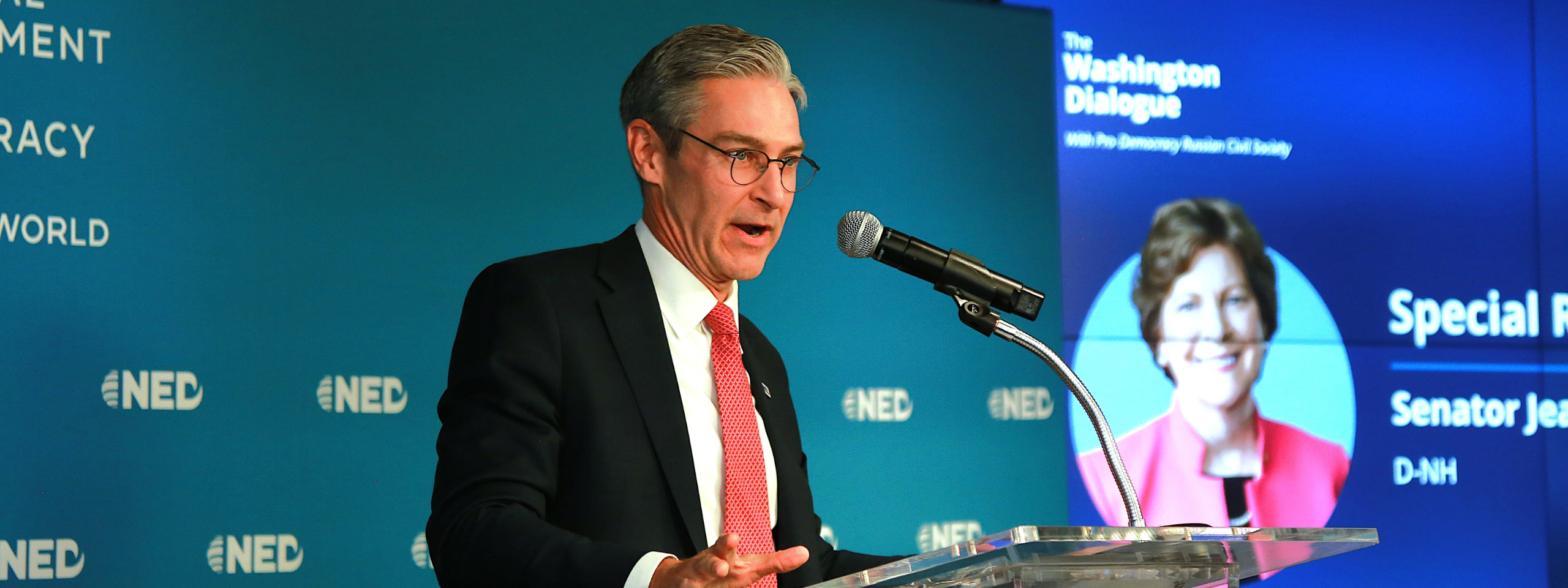
On September 17, NED President and CEO Damon Wilson delivered remarks at the “Second Washington Dialogue: Building a Strategy for Russia’s Democratic Future” convened by NED in Washington, D.C. Building on the inaugural Washington Dialogue in 2024, this landmark event convenes Russian civil society leaders, human rights defenders, independent journalists, technologists, and policy experts with American counterparts. Learn more here.
*****
Good morning and welcome to Washington. It is truly an honor to host all of you at NED. We have a full house. It is wonderful to see so many familiar faces and to see new ones. My sincere thanks to those of you who traveled to be here.
Thank you to our co-organizers, the U.S. Russia Foundation and the Free Russia Foundation. We are so grateful for your partnership in putting on this event and for your partnership in support of Russian civil society. I also want to thank Freedom House, who supported travel for several of our speakers, and will be co-hosting our reception this evening.
This is the second Washington Dialogue. As many of you recall, the inaugural Washington Dialogue took place two years ago and was the largest gathering of the Russian pro-democracy community in the United States in over a decade. It was a proof of concept that a gathering of this kind was possible and that the voices of the Russian pro-democracy community mattered here in Washington. You helped us imagine that a different Russia is possible.
This year’s Dialogue comes at a critical time.
It’s an important year for America. This year, the United States celebrates 250 years since its founding. In 1776, Americans decided they no longer wanted to be subjects of a monarch. They wanted to be citizens of a republic.
That distinction—between a subject and a citizen—is a founding principle of America. And as America’s foundation for freedom, it is also the founding principle of NED. Around the world, NED supports those who fight for the basic dignities of citizenship: to live with the freedom to speak, to worship, to organize, to stand equal before the law and to have a say in the future of their country.
I saw that claim this summer in Ukraine when NED Board members and I traveled to see our partners and witnessed their enduring resolve after more than four years of war.
Ukrainians are fighting for the right to remain citizens of their own country rather than the subjects of Moscow. I think everyone in this room would agree that the fight for Ukrainian freedom is existential for the future of democracy globally, and NED is proud to stand with them in their righteous fight.
The case for supporting Russian democracy is not at all as clear-cut. There are many who question the very premise of “Russian citizenship,” asserting that culturally, historically, even ethnically—Russians are simply doomed by fate or by choice to be subjects of authoritarian rule.
The Russians gathered in this room today represent some of the clearest evidence that this is false. Your work—and your courage—refutes that fatalism.
The persistence, ingenuity, and resilience you display in your work towards a free and democratic Russia is a powerful reminder that many Russians aspire to live in a society where government is accountable to the people and the rights of the individual are protected.
This is an important time for Russia. The Putin regime tries to present the facade of a confident power with the military means to exert its will on the world and the unified support of its public behind it.
For over four years, this facade has been maintained by deepening partnerships with—and increasing economic and military dependence on—Russia’s peers among the world’s most authoritarian states: China, North Korea, Iran, and Cuba.
What the Kremlin presents as public consensus has been manufactured through propaganda, fear, and unprecedented political repression, along with fraudulent displays of legitimacy like the electoral sham to be held this weekend.
An honest assessment of Russia’s circumstances, however, reveals a very different picture: a grinding war of attrition, mounting economic pressure, and growing signs of discontent among a war-weary population. Together, these raise real questions about the sustainability of Putin’s war—and ultimately of his regime.
Authoritarian systems can seem stable, until they are not. They are not resilient. Small fractures can turn into major fault lines. A period of strain can quickly transform into an opening. And that is what the Washington Dialogue is here to explore.
Over the next two days, we will hear that honest assessment of the numerous challenges confronting the Russian regime and the ways that Russian society—both inside and outside of the country—is resisting dictatorship. To those of us here in Washington, your expertise, your insights, and your ground truth is invaluable.
The Kremlin wants Russians and the world to think that there is no alternative to Vladimir Putin, or—even more insidiously—that whatever comes after the Putin regime will be even worse.
We reject this kind of thinking because our understanding of Russian society is informed by independent, expert sources, many of whom are here today.
I look at this room—and I see a much different Russia. I see Nobel Prize Laureates, award-winning journalists, courageous lawyers, and visionary leaders.
I see Russians who insist that the government should answer to its citizens. And I see Russians who, even after being forced into exile, have maintained strong ties to their communities inside Russia.
I see Russian citizens demanding accountability, justice, and representation. Russian citizens who want to see an end to this terrible war in Ukraine—and who understand that ending the war is only the start of the work that is needed.
Tomorrow, we will hear from Russia’s democratic politicians who provide a vision for this future.
You are creating. You are organizing. You are exposing the regime’s abuses and reaching Russians with credible information. You are helping one another. And all of these actions matter.
NED has supported Russian civil society for more than forty years. We have done so through periods of hope and periods of profound repression. And we will continue to stand with those Russians working peacefully for a free and democratic future.
The dignity of citizenship belongs to no single nation or culture. The right to speak freely, to stand equal before the law, to choose your leaders, and to have a say in the future of your country belongs to all people.
It belongs to Russians, too.
The road ahead will be difficult. It will require an end to Russia’s war. It will require accountability for crimes committed in Ukraine and repression at home. It will require reconciliation. And it will require the difficult work of building institutions that serve citizens rather than rule over subjects.
We don’t know when that opening will come.
But when it does, the work you are doing now will matter.
That is why we are here. That is why NED stands with you. And that is why these next two days matter.
Thank you, and let’s get to work.