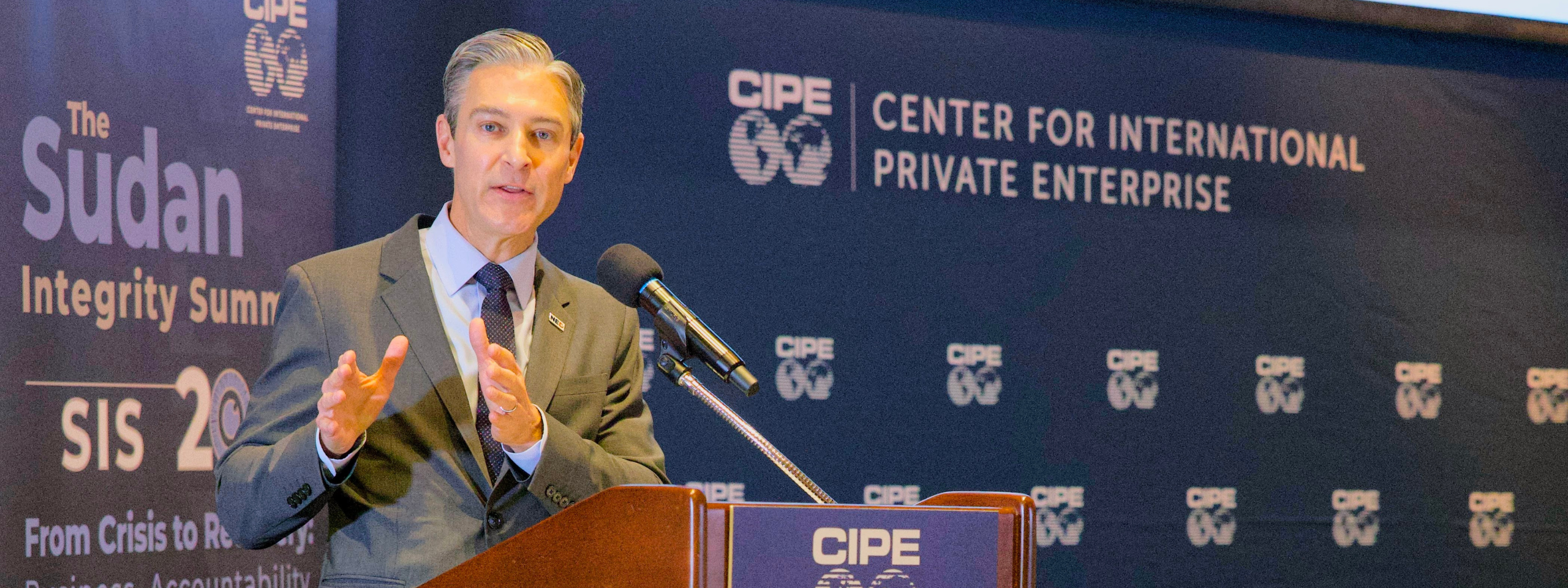
On October 28, NED President and CEO Damon Wilson delivered remarks at the Sudan Integrity Summit 2026, “From Crisis to Recovery: Business, Accountability, and Peace in Sudan,” hosted by the Center for International Private Enterprise (CIPE) in Washington, D.C. The summit brought together Sudanese and international leaders, business representatives, and U.S. policymakers to examine how strengthening independent businesses, accountable institutions, and civic networks can lay the foundation for lasting peace and prosperity.
*****
A Responsibility to Build Democratic and Economic Resilience in Conflict
Good morning.
Thank you to our colleagues at the Center for International Private Enterprise, to Andrew Wilson, Abdu, Lola, and especially to our Sudanese partners and friends—because you refuse to accept that Sudan’s future should be determined by violence.
Our responsibility is to build democratic and economic resilience even in the midst of conflict—to protect and strengthen the people, institutions, networks, and economic foundations that can make peace durable.
For those of you who may know about the Endowment, more than forty years ago, President Ronald Reagan stood at Westminster in the British Parliament and called upon the democratic world to help build what he described as the “infrastructure of democracy”—the institutions that allow people to choose their own way and reconcile their differences through peaceful means. That vision helped inspire the creation of the National Endowment for Democracy.
At the heart of that vision was a powerful idea: the first line of defense for democracy is the people themselves. Democratic government derives its authority from citizens. Its strength comes from their ability to speak, organize, associate, build businesses, demand accountability, and peacefully shape the institutions that govern their lives.
CIPE, one of NED’s four core institutes, embodies an essential part of that vision: citizens need the economic freedom to build livelihoods, organize independently, and hold power accountable.
When that power is usurped—through authoritarianism, corruption, coup, or conflict—the damage extends far beyond politics and beyond a country’s borders. Sudan illustrates the consequences in the starkest possible terms. The war has destroyed lives and communities. UNICEF reported that 33.7 million people needed humanitarian assistance in the first half of this year. More than 17 million of them were children.
Behind those figures are families trying to find food, parents trying to keep their children safe, and communities struggling to hold together. Protecting civilians, securing humanitarian access, and ending this war are urgent.
Sudan’s war is sustained by economic interests as well as military ambitions. Control over companies, commodities, and trade routes gives armed actors resources to keep fighting. Those who profit from the war have powerful reasons to prolong it.
These networks cross borders. Weapons, money, and resources move through them, drawing outside interests into the conflict and spreading instability across the Horn of Africa and the Red Sea. That gives the United States a direct stake in Sudan’s peace and recovery. This summit rightly treats Sudan’s future as a question of regional stability and international security, as well as the rights and aspirations of Sudanese citizens.
There is a lesson about democratic decline in Sudan’s story: the destruction of accountable institutions creates space for forces whose reach extends far beyond the battlefield. Corruption travels. Illicit finance travels. Weapons travel. And insecurity travels with them.
That is why ending Sudan’s conflict is inseparable from weakening the systems through which armed actors and their external backers exploit instability.
But Sudan also offers a lesson about democratic resilience—and it is a hopeful one. We see it in the partners we support across Sudan. Resilience is built before peace arrives.
Even in extraordinary circumstances, Sudanese citizens have continued to organize. Journalists continue to investigate. Civil society continues to document atrocities. Entrepreneurs sustain livelihoods. Businesses serve communities. Reformers prepare the institutions that will be needed when democratic opportunity returns.
And that brings me to the work of our colleagues at CIPE.
CIPE has worked in Sudan since 2017 to strengthen an independent private sector capable of contributing to accountable economic governance. Since 2020, with NED support, CIPE has worked with business associations, civil society, journalists, and diaspora leaders through a democratic transition, a military coup, and ultimately a devastating war.
What is remarkable is how the institutions, ideas, and networks developed through that work have endured. CIPE-supported reformers helped advance nine of eleven proposed amendments into the final draft of the Anti-Corruption Commission Law. Economic Reform Labs produced more than one hundred validated policy recommendations.
CIPE-supported actors established ACT-Sudan and the Business for Peace Taskforce, creating platforms through which Sudanese partners can continue coordinating around accountability, peace, and recovery. And when conflict displaced Sudanese entrepreneurs, CIPE’s work did not stop at the border. Its programming helped refugee entrepreneurs rebuild businesses and reconnect to markets.
A business that reopens can pay workers, restore essential supplies, and give a displaced family greater control over its future. An independent business association can help entrepreneurs advocate for fair rules rather than depend on powerful patrons. These are practical foundations for a more accountable economy.
That is resilience: preserving the ability to act despite crisis. It means keeping knowledge, relationships, and reform ideas alive—and keeping people connected so they can put them to work. This matters enormously because democratic openings are often unpredictable. When they come, countries need institutions and citizens prepared to use them.
This is what we mean at NED by freedom entrepreneurship: backing people who understand their communities and are prepared to try new ways to advance freedom. Those in this room are freedom entrepreneurs. That’s why we provide flexible support, connect them with expertise and one another, and help effective approaches grow. We assess results, learn from what falls short, and adapt.
In Sudan, that means connecting the strengths of independent businesses, journalists, civic organizations, and researchers. Each brings something the others need—from understanding markets to tracing financial flows and organizing communities.
CIPE’s work is an essential part of that broader effort. Its Business for Peace work in Ethiopia, the Sahel, and the Middle East and North Africa reinforces an important lesson: peace needs an economic strategy, just as stable democracies need competitive, resilient economies.
Sudan’s political and military conflict has an economic architecture. CIPE’s work recognizes corruption as part of a system in which military and security actors have exercised extensive influence over state-owned enterprises, strategic industries, and commercial markets.
Recovery must expand opportunity for Sudanese citizens rather than leave the economy in the hands of those who profited from its destruction. That means pursuing peace through political negotiations and an economic recovery strategy that addresses the incentives sustaining violence. The business community has a central role to play.
We need to understand the economic networks that sustain conflict.
We need to disrupt illicit financial flows and the markets that reward violence.
We need transparency around commodities and strategic resources.
We need sanctions and accountability tools that impose costs on those profiting from conflict while protecting legitimate businesses and ordinary citizens.
We need independent businesses capable of creating livelihoods outside the war economy.
And we need to begin laying the foundations for responsible investment and reconstruction before the conflict ends.
The test is whether these efforts help Sudanese citizens earn a living, compete fairly, and have a voice in the decisions that affect them. CIPE is already carrying that thinking forward. Its current work includes building civil society’s capacity to monitor the war economy, track corruption, and scrutinize humanitarian and recovery resources. That work points toward an important principle: economic governance is something Sudan must address now. Better economic governance can help create the conditions for lasting peace.
That is also why this summit matters. Holding it in Washington is an opportunity to connect Sudanese-led priorities with American policymakers, businesses, and international partners.
The first Sudan Integrity Summit strengthened relationships among businesses, civil society, anti-corruption advocates, journalists, researchers, and policymakers. It raised the visibility of Sudanese-led accountability efforts and created a platform for collaboration.
This second summit asks us to go further. It connects business with peace, recovery with accountability, investment with integrity, and democratic transition with economic governance.
Its purpose is to identify practical reforms that support accountable institutions, competitive markets, and sustainable peace—and to strengthen the private sector’s role in humanitarian response, recovery, reconstruction, and peacebuilding.
The private sector brings capabilities that this effort needs: knowledge of markets, logistics, payments, technology, and how to keep an enterprise operating under pressure. The question is how to put those capabilities to work alongside Sudanese civic leadership, with transparency about who owns a company, who finances it, and who benefits.
Building democratic and economic resilience means refusing to wait for ideal conditions before investing in people’s capacity to act. Ending the war is urgent. But we cannot treat peace, economic recovery, accountability, and democratic renewal as separate tasks to be undertaken one after another. The experience represented in this room tells us why.
If we wait until the guns fall silent to build accountable institutions, we will have waited too long.
If we wait until reconstruction begins to confront corruption, corrupt networks may already control reconstruction.
If we wait for democratic transition before protecting civic space, there may be too little civic space left to sustain that transition.
And if we wait until peace to support independent businesses, the economic foundations of peace may already belong to those who profited from war.
So our responsibility is to build now: to sustain independent businesses and civic networks, protect independent information, expose the interests sustaining the war, and prepare for accountable recovery.
Most importantly, we must remember whose choices must guide this work: the Sudanese people. The entrepreneurs rebuilding businesses in displacement. The journalists continuing to investigate. The civic leaders documenting abuses. The business associations advocating for reform. The citizens insisting that justice must accompany peace.
The people who believe that Sudan belongs to its citizens, whatever force is brought against them. They are the first line of defense for Sudan’s democratic future. NED’s commitment to Sudan rests on our partnership with these citizens. Our role is to support their ability to organize, build, and choose their own future.
Sudanese ownership must guide the work, and accountability must guide how we support it. Their determination reminds us that resilience includes preserving the freedom, knowledge, relationships, and economic independence needed to build something better.
So let this summit recognize those who have continued, against extraordinary odds, to work for peace, accountability, and justice. Let us invest in them. Let us protect the civic and economic space they need to act. And let us make sure that when Sudan’s next opening comes, they have the institutions, networks, ideas, and resources necessary to seize it.
Our responsibility is to help preserve the foundations on which Sudanese citizens can build the peace, prosperity, and democratic future they deserve.
Thank you.